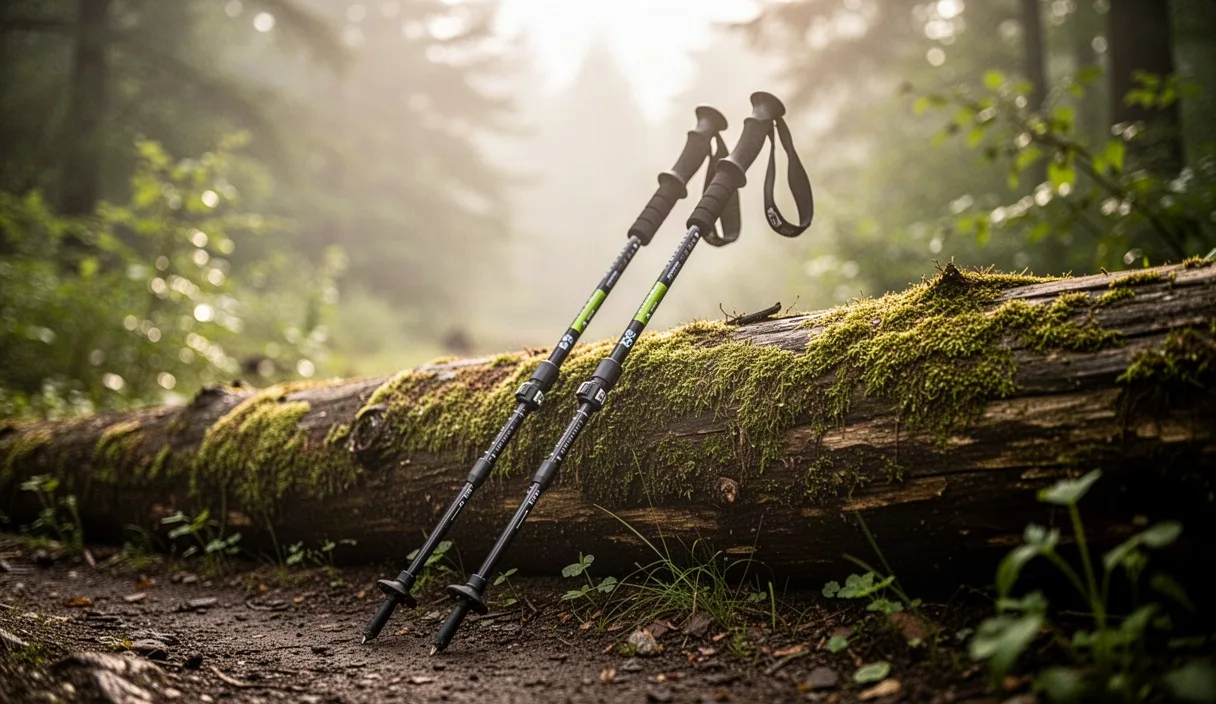

Trekking poles are among the least glamorous items on a gear list, yet they influence knee comfort, balance on scree, and pace on long descents more than most walkers expect. The market now offers a wide spread of shaft materials, locking systems, and tip configurations, and the right combination depends heavily on the terrain a walker frequents and the loads carried.
This guide compares the practical differences between carbon and aluminum construction, fixed-length and adjustable designs, and the smaller components, grips, baskets, and tips, that determine how a pole performs in mud, snow, or on exposed rock. It closes with guidance on sizing, price expectations, and simple maintenance habits that extend a pair of poles well beyond a single season.
Aluminum vs. Carbon Fiber: Weight and Durability Trade-offs
Aluminum poles, typically built from 6000 or 7000 series alloy, remain the standard choice for walkers who prioritize resilience over minimal weight. A typical aluminum pole weighs between 220 and 280 grams per pole, and under excessive lateral stress it tends to bend rather than snap. A bent aluminum shaft can often still be used to finish a trip, even if it is no longer perfectly straight.
Carbon fiber poles, by contrast, usually weigh between 170 and 210 grams per pole, a difference of roughly 40 to 60 grams that becomes noticeable over several hours of use, particularly for walkers who swing their poles rhythmically rather than plant them heavily. Carbon's drawback is its failure mode: under a sharp lateral impact, such as a pole trapped between two rocks while the walker's weight shifts suddenly, carbon shafts tend to shatter rather than deform, which usually means the pole is unusable for the remainder of the outing.
Some manufacturers address this by combining materials, an aluminum lower section paired with a carbon upper, which keeps weight down while retaining some resistance to snapping near the tip. This hybrid approach costs more than a full aluminum set but less than a full carbon set.
| Material | Typical weight per pole | Failure mode | Best suited for |
|---|---|---|---|
| Aluminum | 220-280 g | Bends, remains usable | Rocky, off-trail, long expeditions |
| Carbon fiber | 170-210 g | Snaps, often unusable | Established trails, fastpacking |
| Hybrid (mixed) | 195-240 g | Partial resistance to snapping | Mixed terrain, general touring |
Fixed-Length vs. Adjustable Poles for Different Trips
Fixed-length poles have no locking mechanism, which removes a common point of failure and shaves weight, often 30 to 50 grams per pole compared with an equivalent adjustable model. They suit walkers who stick to one general type of terrain, such as through-hikers on a relatively consistent grade, and who already know their correct length from prior trips.
Adjustable poles, using either twist-lock or lever-lock (flick-lock) systems, allow length changes on the move, useful for a single trip that includes flat approach trails, steep switchbacked ascents, and technical descents. Lever-lock systems have largely replaced twist-lock designs in mid-range and premium poles because they are easier to adjust with gloved hands and less prone to slipping under load; twist-lock mechanisms can loosen gradually if grit works into the threads.
Packability is another factor. Many adjustable poles now use a folding, tent-pole-style design that collapses to 33-40 centimeters, fitting inside a pack for scrambling sections or air travel, whereas telescoping adjustable poles typically collapse to 60-65 centimeters and fixed-length poles do not collapse at all beyond their single molded size.
- Choose fixed-length for consistent terrain and minimal weight, such as a single-grade ridge walk.
- Choose telescoping adjustable for varied day hikes where length changes are needed but packability is secondary.
- Choose folding adjustable for trips involving scrambling, air travel, or storage in a smaller pack compartment.
Grip Materials and Their Effect on Comfort
Cork grips, often blended with rubber compound, mold gradually to a walker's hand shape and manage moisture from sweat reasonably well, which makes them a common choice for warm-weather use over multi-hour outings. Cork can feel slightly firm during the first several uses before it softens.
Foam grips are lighter and absorb moisture more readily, which some walkers find comfortable in humid conditions but others find leads to a damp, less secure feel by midday. Rubber grips insulate better against cold and vibration, making them suited to winter use or rocky descents where shock transmission is a concern, though rubber can feel tacky and slightly heavy in warm weather.
Grip extensions, foam or rubber sections running 10-15 centimeters below the main handle, allow a walker to choke down on the pole during steep traverses or short climbing moves without adjusting the locking mechanism. This feature appears mainly on mid-range and premium poles and is worth checking for anyone who frequently side-hills.
Setting Correct Pole Length for Uphill and Downhill Use
A commonly used baseline is to set pole length so that, standing upright with the pole tip on the ground and elbow bent at roughly a 90-degree angle, the grip sits level with the hand. For most adults this translates to a length between 110 and 130 centimeters, though torso and arm proportions vary, so this figure should be treated as a starting point rather than a fixed rule.
On sustained uphill sections, shortening each pole by 5 to 10 centimeters keeps the elbow angle comfortable and prevents the walker from reaching awkwardly forward and up. On sustained downhill sections, lengthening each pole by 5 to 10 centimeters beyond the baseline setting helps absorb impact earlier and reduces strain on the knees during braking steps.
On sidehill or traversing terrain, some walkers set the uphill-side pole shorter and the downhill-side pole longer, a technique borrowed from ski touring, though this requires practice and is not necessary for casual day hikes. Adjustable poles make these changes practical mid-trip; fixed-length pole users must accept a single compromise setting for the entire route.
Basket and Tip Options for Mud, Snow, and Rock
Standard trekking baskets, roughly 4-5 centimeters in diameter, are designed for general trail use and prevent the pole tip from sinking too far into loose soil or light mud. Wider snow baskets, often 8-10 centimeters, distribute pressure over soft snow and are typically sold as an aftermarket accessory that screws onto the same tip threading.
Carbide tips have become the standard for most poles because they bite reliably into rock, packed dirt, and ice, and they resist wearing down for a full season of regular use under normal conditions. Rubber tip covers can be added over the carbide point for use on pavement, boardwalks, or rock slab sections where a bare metal tip would be noisy or slightly slippery; these covers wear through after roughly 100-150 kilometers of hard surface contact and need periodic replacement.
For mixed rock and root terrain, some walkers remove baskets entirely to allow the tip to seat more precisely between obstacles, though this increases the risk of the tip sinking into soft patches unexpectedly. It is worth carrying a spare tip or basket on longer trips, since these small parts occasionally work loose or shear off on sharp rock edges.
Price Ranges and What They Typically Reflect
Entry-level aluminum poles, generally priced from 25 to 50 currency units per pair, use twist-lock adjustment, basic foam grips, and heavier alloy tubing. They perform adequately for occasional day hikes but the locking mechanisms and grips tend to wear noticeably within one to two seasons of regular use.
Mid-range poles, usually 60 to 110 currency units per pair, introduce lever-lock adjustment, cork or rubber grips, and lighter aluminum or hybrid shafts. This tier represents a reasonable balance for most walkers doing weekend trips several times a month.
Premium poles, often 120 to 220 currency units per pair, use full carbon construction, refined folding mechanisms, and grip extensions, with weight savings that matter most to fastpackers or trail runners covering long distances. Beyond this range, price increases typically reflect marginal weight reductions rather than meaningful gains in durability.
Maintaining Poles Between Weekend Outings
After a muddy or wet outing, poles should be extended fully and wiped down with a damp cloth, paying attention to the locking mechanism area where grit accumulates. Twist-lock poles benefit from being disassembled at the internal expander every few trips so the mechanism can be cleaned and lightly dried, since trapped moisture can cause the expander to seize.
Tips should be checked for wear before each trip; a carbide tip that has visibly rounded off no longer bites into rock or ice reliably and should be replaced, a straightforward task on poles with a screw-in tip design. Grips that have started to peel or crack, common with foam after two to three seasons, can usually be replaced with an aftermarket grip kit rather than requiring a new pole.
Poles should be stored fully dry and, if adjustable, left slightly loosened rather than locked at maximum tension, since prolonged tension can stress the locking mechanism over months of storage.
Common mistakes
- Setting pole length once at home and never adjusting for sustained climbs or descents on the trail.
- Storing wet aluminum or carbon poles in a closed bag, which encourages corrosion at metal joints and mildew on cork grips.
- Choosing full carbon poles for off-trail scrambling where lateral rock contact is frequent, increasing the risk of a snapped shaft far from the trailhead.
- Ignoring a worn or missing rubber tip cover on hard-surface sections, which can cause an unexpected slip on smooth rock or pavement.
Next steps
Walkers choosing a first pair should consider their typical terrain before material: aluminum for rocky or off-trail routes, carbon for established trails where weight matters more than impact resistance. Trying on grips in person, where possible, helps more than reading specifications, since hand size and sweat tendency vary considerably between individuals.
Anyone experiencing persistent wrist, shoulder, or knee discomfort while using poles should consult a physiotherapist or qualified outdoor instructor, since pole length or technique adjustments alone may not resolve an underlying joint issue.