
Selecting insulation for a three-season pack is one of the more consequential decisions a walker makes before ever setting foot on a trail. The choice between down and synthetic fill affects not only how warm one remains at camp but also how much weight must be carried, how the garment or sleeping bag behaves when wet, and how long the investment will serve across repeated seasons of use. This is not a matter of one material being categorically superior to the other; rather, it is a question of which properties matter most for a given itinerary, climate, and budget.
This article examines the construction of each fill type, compares their performance across the metrics that matter most to hikers, and offers guidance on matching insulation choice to regional conditions. Readers planning a spring traverse of damp lowland trails will find different recommendations here than those preparing for a dry autumn ridge walk, and the sections below are organized to make those distinctions clear.
How Down and Synthetic Fill Are Constructed
Down insulation consists of the fine, plumose clusters found beneath the tougher exterior feathers of ducks and geese. Each cluster branches into thousands of tiny filaments that trap air, and it is this trapped air, not the down itself, that provides warmth. Quality is measured in fill power, a laboratory measurement of the volume in cubic inches that one ounce of down will occupy when lofted. Fill power ratings for three-season gear commonly range from 550 to 800, with premium expedition-grade products reaching 900 or higher.
Synthetic insulation, by contrast, is manufactured from polyester fibers engineered to mimic the loft and air-trapping structure of down. These fibers are produced in two general forms: continuous filament, where long strands are laid in sheets, and short-staple fiber, where shorter strands are cross-linked to resist shifting. Brand names such as PrimaLoft, Climashield, and Thermolite represent proprietary variations on this basic approach, each adjusting fiber diameter and cross-section to balance compressibility against durability.
A practical distinction worth noting is that down requires a shell fabric and internal baffling to keep the clusters evenly distributed, since loose down will migrate and create cold spots. Synthetic fill, being manufactured in sheet form, can be cut and layered directly into a garment or bag without baffles, which simplifies construction and reduces the number of seams that might eventually leak insulation or admit moisture.
Comparing Warmth-to-Weight Ratios
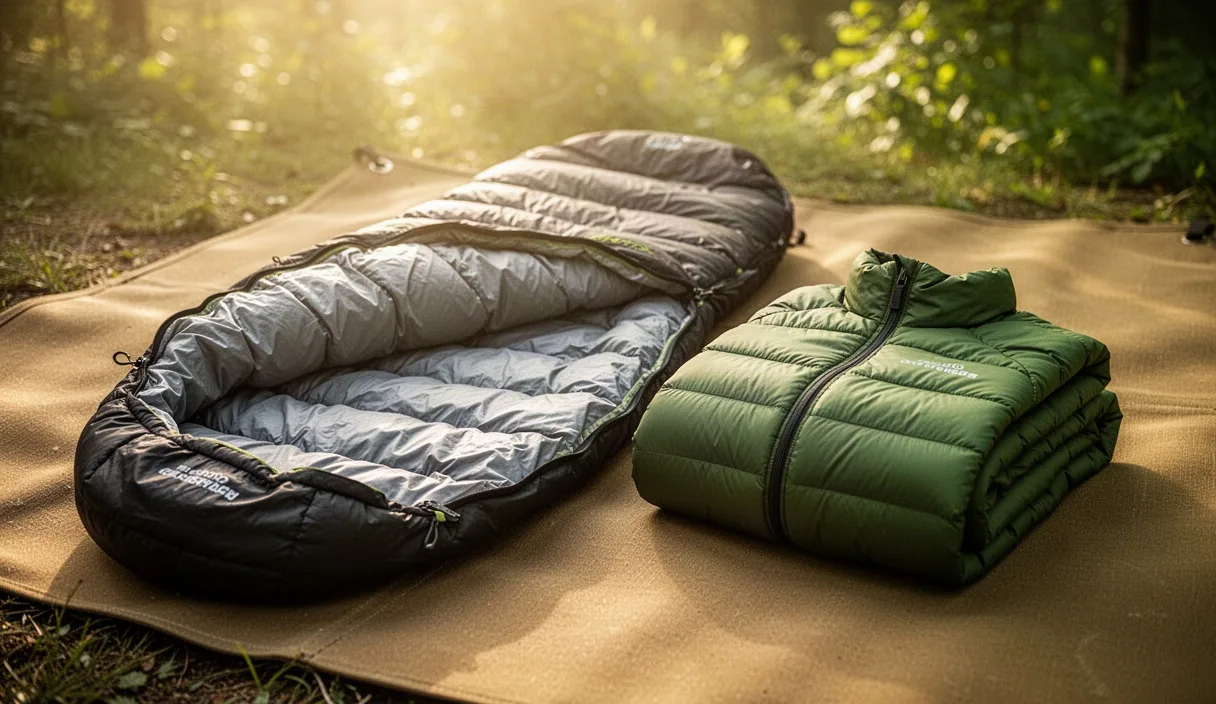
Warmth-to-weight ratio is the metric most often cited when comparing these two fill types, and down wins this comparison decisively under dry conditions. A sleeping bag rated to 20 degrees Fahrenheit filled with 800-fill-power down typically weighs between 1.5 and 2 pounds less than a synthetic bag rated to the same temperature. For a three-season pack where every ounce is weighed against trail mileage, this difference is significant over a multi-day itinerary.
Synthetic fill requires roughly 20 to 30 percent more material by weight to achieve equivalent loft and warmth. This is because the individual fibers are heavier and less efficient at trapping air than down clusters. A jacket insulated with 60 grams per square meter of synthetic fill will generally provide warmth comparable to a jacket with three to four ounces of 650-fill down, but the synthetic garment will weigh noticeably more.
The following comparison illustrates typical figures for a mid-weight insulated jacket intended for shoulder-season use:
| Attribute | Down (650 fill power) | Synthetic (60g/m2) |
|---|---|---|
| Approximate weight | 14 ounces | 18 ounces |
| Packed volume | Small, compresses to fist size | Moderate, roughly 30 percent larger |
| Warmth in still, dry air | High | Moderate to high |
| Warmth if damp | Reduced significantly | Retained substantially |
Performance When Exposed to Moisture
Moisture resistance is where synthetic insulation earns its reputation as the more forgiving choice. When down clusters become saturated, the filaments collapse against one another, eliminating the air pockets responsible for warmth. A soaked down jacket can lose the majority of its insulating capacity and may take a full day or longer to dry fully in the field, even with intermittent sun exposure.
Synthetic fibers, being hydrophobic, do not absorb water in the same way. Individual fibers may become wet on their surface, but the fiber structure itself retains much of its loft even when damp, and it dries considerably faster, often within a few hours near a fire or in a breezy, sunny spot. This makes synthetic fill a sensible choice for trips involving stream crossings, persistent drizzle, or condensation-prone tent conditions.
Manufacturers have addressed down's vulnerability with hydrophobic treatments applied at the cluster level, marketed under names such as DownTek or Hyperdry. These treatments slow water absorption and can extend the window before performance degrades, but they do not eliminate the underlying weakness. A treated down bag left in a leaking tent overnight will still lose significant loft, whereas a synthetic bag in the same circumstance will retain most of its function.
Packability and Long-Term Durability
Down compresses more efficiently than synthetic fill, a property that matters considerably when pack volume is limited. A three-season down sleeping bag typically compresses to the size of a large loaf of bread, while a synthetic bag rated to the same temperature may require a stuff sack nearly twice that volume. Over repeated trips, this difference can determine whether a bear canister or extra food supply fits comfortably in the same pack.
Durability, however, favors synthetic insulation over the long term. Down clusters can be permanently crushed by repeated compression cycles, and clusters lost through worn seams or torn shell fabric do not regenerate. A well-cared-for down bag might lose 10 to 15 percent of its loft after several hundred compression cycles spanning many years of use. Synthetic fibers, being more resilient to mechanical compression, generally hold their loft longer, though the fibers do eventually break down and lose some resilience after extensive use, typically becoming noticeable after three to five years of regular trips.
One consideration often overlooked is how each fill type behaves after being stored compressed for extended periods, such as during off-season months. Down recovers loft more slowly after long-term compression and benefits from being stored loose in a large mesh sack rather than its stuff sack. Synthetic fill recovers loft more readily, making it somewhat more tolerant of imperfect storage habits.
Cost Differences Over Several Seasons of Use
Down insulation carries a higher upfront cost, often 40 to 70 percent more than a comparably rated synthetic product. A quality three-season down sleeping bag from a reputable manufacturer commonly retails between 250 and 400 US dollars, while a synthetic equivalent might range from 130 to 220 dollars. This price gap widens further at higher fill powers, since sourcing and processing premium down is labor-intensive.
Over a multi-year horizon, the calculation shifts somewhat. Down products, if cared for properly, retain functional performance for eight to twelve years of moderate use, effectively spreading the initial cost across a longer service life. Synthetic products, while cheaper initially, often need replacement after four to six years of regular use as the fibers lose resilience, meaning a hiker may purchase two synthetic bags in the time it takes to wear out one down bag.
For a hiker who takes three or four multi-day trips per year, the lifetime cost of down and synthetic insulation often converges to within a modest range of one another once replacement cycles are factored in. Those who hike far less frequently, perhaps only a handful of nights annually, may find synthetic's lower upfront cost the more sensible choice, since the durability advantage of down becomes less relevant when usage is light.
Matching Insulation Type to Regional Climate
Climate and typical trail conditions should weigh heavily in this decision. Hikers planning routes through the Pacific Northwest, the Appalachian corridor, or any region where fog, drizzle, and high humidity are common companions will generally find synthetic insulation more reliable, since the odds of prolonged dampness are higher and drying opportunities are less frequent.
Conversely, hikers in the arid ranges of the American Southwest, the high desert of the Colorado Plateau, or similar dry continental climates will benefit more from down's superior warmth-to-weight ratio, since the risk of sustained moisture exposure is lower and pack weight savings become the dominant concern over multi-day routes with significant elevation gain.
For those hiking in climates that shift unpredictably, a hybrid strategy is worth considering: a synthetic-filled jacket for active layers prone to sweat and precipitation, paired with a down sleeping bag protected inside a waterproof compression sack for nighttime warmth. This combination allows each fill type to be used where its strengths are most relevant.
Care and Storage Practices for Both Fill Types
Down items should be washed infrequently, generally no more than once or twice per season, using a down-specific detergent free of standard surfactants that strip natural oils from the plumes. Machine drying on low heat with several clean tennis balls added to the dryer helps break up clumps and restore loft; this process can take two to three hours and should not be rushed with high heat, which risks scorching the shell fabric.
Synthetic insulation tolerates washing more readily and can be laundered with standard technical-fabric detergent every few trips without significant risk to fiber structure. Both fill types should always be air-dried or laundered in front-loading machines, since top-loading machines with agitators can damage baffles and shell seams over repeated cycles.
For storage between seasons, down products should be kept loose or loosely folded in a large breathable cotton or mesh sack, never compressed in a small stuff sack for months at a time, as prolonged compression accelerates loft loss. Synthetic products are more forgiving of compressed storage but still benefit from being stored uncompressed when closet space allows.
Common Mistakes
- Choosing down for a trip with a high likelihood of rain or stream crossings without a reliable waterproof storage method, such as a dry bag or waterproof compression sack.
- Washing down with regular household detergent, which strips the natural oils and reduces loft over time.
- Storing either fill type compressed in its stuff sack for extended off-season periods, which shortens the effective lifespan of the loft.
- Assuming higher fill power always means a warmer garment, without accounting for the total fill weight, which is the actual determinant of warmth.
- Overlooking shell fabric quality, since a poorly constructed shell can undermine the performance of even premium insulation by allowing wind penetration or moisture ingress.
Practical Next Steps
Hikers preparing a three-season kit should begin by reviewing the typical weather patterns for their intended routes over the past several years, since regional climate data will do more to guide this decision than any general rule of thumb. Consulting trip reports from local hiking clubs or regional forums can offer a realistic sense of how often precipitation or high humidity is likely to be encountered.
From there, it is worth trying on or testing both fill types in person where possible, paying attention to how each garment compresses in a pack and how it feels against the skin during light activity. Those investing in a sleeping bag or jacket intended for years of use should also budget for proper care supplies, including down-specific detergent and a large mesh storage sack, as these small additions meaningfully extend the working life of the insulation regardless of which type is chosen.