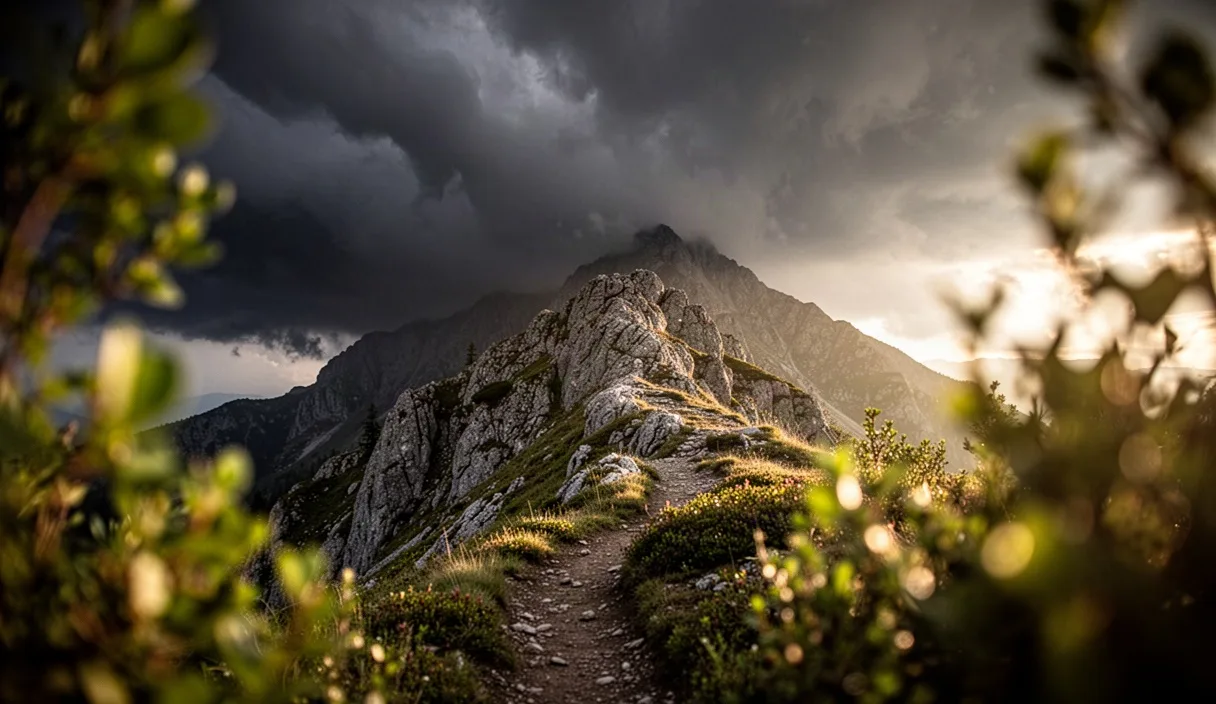
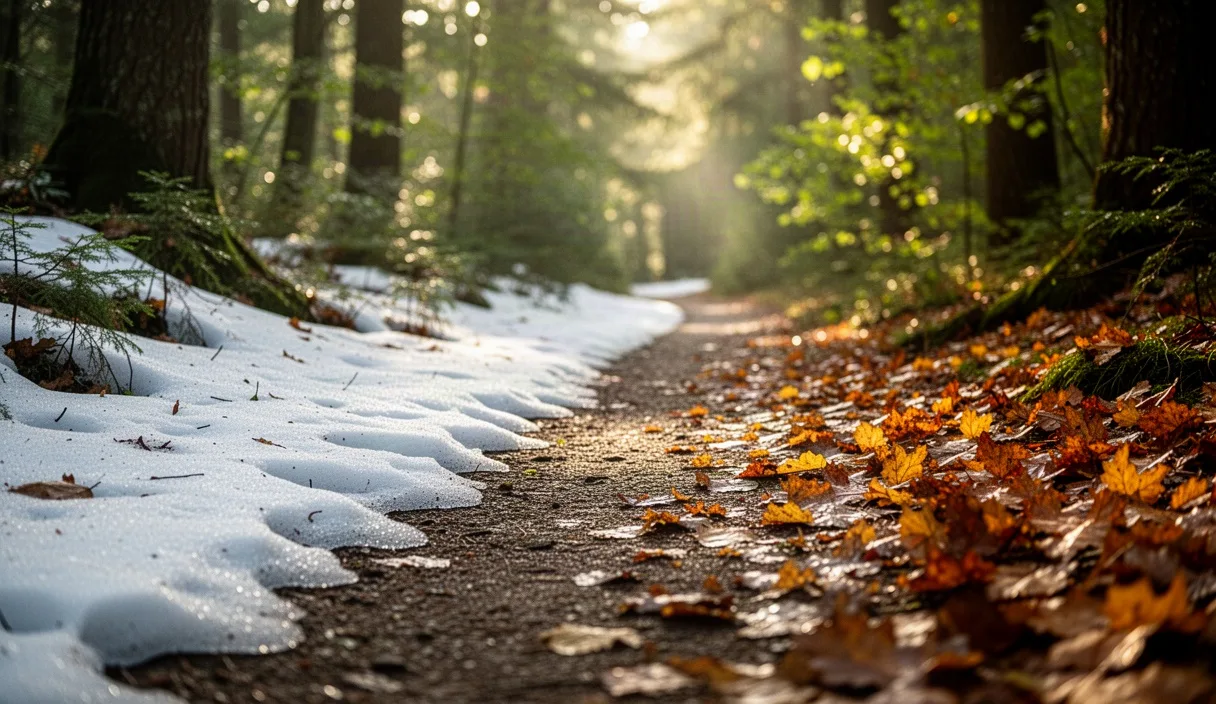

Shoulder-season hiking, that is to say the weeks bracketing the depths of winter and the height of summer, presents a set of conditions that many hikers underestimate. Spring and autumn are often grouped together in guidebooks as "moderate" seasons, yet the two are, in practice, quite different in how they treat a trail, a body, and a pack. A ridge that is firm and dry in October may be a running stream of meltwater in April, and a forest that offers dappled shade in May may be a carpet of slick, decaying leaves by November.
This article sets out the practical distinctions a walker ought to consider before setting out in either season, from the ground underfoot to the contents of the pack. Readers who plan trips across both spring and autumn will find that a single packing list or a single mental checklist rarely serves both seasons equally well.
Ground Conditions: Mud and Snowmelt vs. Dry Leaf Litter
Spring trails are shaped chiefly by what the winter has left behind. As snowpack retreats, particularly at elevations above roughly 1,200 metres in temperate ranges, meltwater saturates soil that has not yet had a chance to dry. The result is mud, sometimes ankle-deep, along low-lying stretches, switchbacks, and anywhere water naturally pools. Trails through clay-heavy soil are especially prone to this, and a boot that sinks six centimetres into mud on a March morning may find the same trail firm by late May.
Autumn presents an almost opposite problem. Dry conditions accumulated over summer leave trails firm, but the arrival of fallen leaves, often several centimetres deep on wooded paths by mid-October, conceals roots, loose stones, and uneven footing. A walker cannot see what lies beneath the litter, and ankle strain is a common complaint on autumn descents for this reason. Wet leaves after autumn rain add a further slickness that can rival ice in its unpredictability.
Trekking poles are of particular use in both seasons, though for different reasons: in spring, they test the depth and stability of mud before a foot commits; in autumn, they probe leaf litter for hidden obstacles. Hikers should also expect trail erosion control structures, such as water bars or duckboards, to see heavier use and faster wear during spring melt.
Temperature Swings Between Day and Night in Each Season
Spring days often warm quickly under strengthening sun, sometimes reaching 15 to 18 degrees Celsius by early afternoon, while overnight lows can still drop close to freezing, particularly in valleys where cold air settles. This swing of ten degrees or more within a single day is common in April and early May in temperate mountain regions.
Autumn swings tend to be sharper still. A clear October day might reach 14 degrees Celsius at midday, but once the sun drops behind a ridge, temperatures can fall rapidly, sometimes by eight to ten degrees within an hour, as there is less atmospheric moisture to retain daytime warmth compared with spring. Hikers who plan an afternoon return should account for this drop, especially on exposed ridgelines where wind chill compounds the effect.
A practical rule worth adopting: check both the forecast high and the forecast low for the trailhead elevation, then add a margin of three to four degrees colder for higher points along the route, since temperature typically falls by roughly 6.5 degrees Celsius per 1,000 metres of ascent under standard atmospheric conditions.
Wildlife Behavior Differences Worth Knowing
Spring coincides with the emergence of many animals from winter dormancy and the start of breeding season for numerous species. Ground-nesting birds may be present on open trail sections, and hikers should avoid lingering near visible nests. In bear country, spring is when animals emerge hungry from hibernation and may be encountered at lower elevations than expected, foraging for early vegetation.
Autumn brings a different set of behaviors tied to preparation for winter. Large mammals such as deer and elk enter rutting season, typically from September through October depending on species and region, and males can display heightened aggression during this period. Bears in autumn are often engaged in hyperphagia, consuming large quantities of food before winter, and may be encountered near berry patches or fruit trees along lower trail sections.
- Spring: insect activity, particularly ticks and early mosquitoes, increases sharply as temperatures rise above roughly 10 degrees Celsius.
- Autumn: insect activity declines after the first hard frost, though wasps can be notably aggressive in the weeks beforehand.
- Both seasons: carrying bear spray where relevant and storing food properly overnight remains advisable; hikers unfamiliar with local wildlife regulations should consult a park ranger station before departure.
Adjusting Layering Systems for Each Season
A spring layering system needs to manage both dampness and cold. A moisture-wicking base layer remains standard, but the mid layer should account for the likelihood of the hiker becoming wet from either sweat or trailside splashing through mud and slush. A softshell or fleece mid layer that retains some insulating value when damp is preferable to down, which loses loft when wet.
Autumn layering can lean more heavily on down or synthetic insulation for the mid layer, since precipitation is typically less persistent than spring's mix of rain and melting snow, though early-season snow is possible at higher elevations by late October in many temperate ranges. A windproof outer shell becomes more important in autumn given the sharper evening temperature drops described earlier.
| Layer | Spring priority | Autumn priority |
|---|---|---|
| Base | Quick-drying synthetic | Synthetic or merino wool |
| Mid | Fleece, tolerant of dampness | Down or synthetic insulation |
| Outer | Waterproof shell | Windproof shell, water-resistant |
| Extremities | Waterproof gloves and gaiters | Insulated gloves and a warm hat |
Daylight Availability and Its Effect on Trip Timing
Daylight in spring is expanding, often by three to four minutes each day around the equinox, which gives hikers a growing margin for longer outings as the season progresses. A trip planned for early March may need to conclude by 6 p.m., while the same trailhead by late May might allow for a return past 8 p.m. in daylight.
Autumn daylight is contracting at a similar rate but in the opposite direction, and this is where planning errors most often occur. A hiker accustomed to September's longer evenings can be caught out by late October, when sunset may arrive a full two hours earlier than it did just eight weeks prior. Starting a hike at what felt like a reasonable midday hour in September can leave a party finishing the final kilometre in near-darkness by late October.
A dependable practice in both seasons is to check the specific sunset time for the trailhead's location on the day of the hike, then plan to be off any exposed or technical terrain at least 45 to 60 minutes before that time, reserving the remaining light for the approach back to the trailhead or vehicle.
Water Source Reliability in Spring vs. Autumn
Spring generally offers abundant water. Snowmelt swells streams that may be barely a trickle by midsummer, and this is often the season when water is least likely to run short on a multi-day route. The tradeoff is that fast-moving meltwater can be difficult and occasionally dangerous to cross, and water sources may carry more sediment, requiring more frequent filter changes.
Autumn is typically the drier end of the water-reliability spectrum, since summer's demand has drawn down many seasonal streams and they have not yet been replenished by autumn or winter precipitation. A stream marked reliable on a spring map may be dry by late September in a low-snowpack year. Hikers should verify current water source status through ranger stations or recent trip reports rather than relying solely on seasonal averages.
A water filter or purification tablets remain necessary in both seasons regardless of apparent water clarity, since biological contamination is not reliably visible to the eye.
Packing List Adjustments Between the Two Seasons
Certain items shift in priority depending on the season, even when the overall pack weight remains similar.
- Spring additions: gaiters for mud and residual snow, a lightweight trowel if trail conditions require off-trail routing around washouts, and insect repellent as temperatures climb.
- Autumn additions: a headlamp with spare batteries given the earlier sunsets, an extra insulating layer for the sharper evening cold, and blaze-orange clothing where hunting seasons overlap with hiking trails, a detail hikers should confirm with the local land management agency.
- Shared but season-sensitive: a map and compass or GPS device, since spring mud can obscure trail markers and autumn leaf litter can bury the trail bed itself.
Common Mistakes
One frequent error is applying a single season's packing list to the other simply because both are labeled "mild." A hiker who assumes autumn will be as wet underfoot as spring may skip gaiters, then find dry leaf litter far more slippery than expected on a descent. Another common mistake is underestimating the daylight contraction in autumn, leading to a rushed or headlamp-lit final stretch. Finally, many hikers neglect to verify water source status in early autumn, trusting a spring-season map that no longer reflects current stream flow.
Practical Next Steps
Hikers preparing for a shoulder-season trip should check a recent trip report or ranger update specific to the trail and the current week, rather than relying on seasonal generalities. Packing a layering system suited to the specific season's moisture and temperature pattern, confirming sunset time before departure, and carrying a reliable water treatment method regardless of apparent source reliability are all reasonable baseline precautions. For routes involving stream crossings, elevation above 2,000 metres, or known wildlife activity, consulting a local ranger station or an experienced guide beforehand remains a sensible step rather than an optional one.